
Product FAQ

Fast Lane ADA-Compliant Checkout
We named it Fast Lane because the ADA requires that the main checkout be open at all times, hence the Fast Lane. This is the latest on this requirement.
We currently fit the following devices:
- Ingenico Axium and Telium Tetra devices
- Verifone MX 915, 925, and M400
We do not fit End-Of-Service-Life terminals.
ADA 2010 Standards for Accessible Design – §904.4 & §904.4.1
For check-out aisles and sales counters, the ADA Standards require:
- At least one of each type of checkout shall be accessible
- Accessible checkouts shall remain open whenever checkouts are open to serve customers
Reference
2010 ADA Standards §904.4.1 (Check-Out Aisles)
Key phrase: They shall be open whenever check-out aisles are open to serve the public.
This means if the store has 10 lanes, and only one is ADA-accessible, that lane must not be closed, used for storage, or blocked by displays.
Full ADA and CAL-Fin 13082 Compliance
100%Product FAQ
If a credit card terminal checkout is not accessible to a person in a wheelchair, is that a federal ADA law violation?
Here’s how it breaks down legally and practically
Below are the main legal points and practical implications for checkout terminal accessibility under federal ADA law.
1. ADA Title III – Public Accommodations
Under Title III of the Americans with Disabilities Act (ADA), all places of public accommodation — including stores, restaurants, and service counters — must provide equal access to goods, services, and payment methods for individuals with disabilities.
This includes checkout counters and payment devices such as credit card terminals, PIN pads, and touchscreen readers.
2. Specific ADA Standards That Apply
- Controls and operable parts (card readers, touchscreens) must be within reach range for a person seated in a wheelchair.
- Typically no higher than 48 inches for a forward approach or 54 inches for a side approach, with adequate clear floor space.
- Operable parts must be usable with one hand and without tight grasping, pinching, or twisting.
- Required actuation force must not exceed 5 pounds.
This section governs interactive payment interfaces (e.g., PIN entry, display, privacy). DOJ guidance applies these same requirements to POS terminals, as their use and functions are equivalent.
3. Common Violations
- The terminal is mounted too high or too far back to reach from a wheelchair.
- The device is fixed in position (cannot be tilted, pulled forward, or held).
- The screen or keypad is angled so that a seated user cannot see or reach it.
- A cashier must assist with PIN entry, violating privacy and independence requirements (§707.4).
4. Legal and Enforcement Context
The DOJ and U.S. Access Board have clarified that card readers are part of the transaction counter and must be accessible. Private lawsuits and DOJ settlements often reference ADA §36.302 (“modifications in policies, practices, or procedures”) and §36.402 (“readily achievable barrier removal”).
5. In Plain Terms
If a wheelchair user can’t independently reach, see, or use a credit card terminal during checkout, that constitutes a violation of ADA Title III.
Businesses are required to provide equal, private, and independent use — not just access to the counter itself.
01. What services/products do you offer?
01. What services/products do you offer?
For ADA TITLE III and TITLE II Public-Facing Businesses, including city and state entities:
We manufacture the only ADA and California Financial Code §13082 compliant POS mounting stands on the market. Each stand is designed for full accessibility and compliance with PCI PIN Transaction Security (PTS) – Point of Interaction, ISO 9563, and VISA Accessibility TADG 3.3, Section 2.6 requirements. Available in standard and custom-engineered builds, every Taylor ADA Mount is built under our U.S. Patent, ensuring both accessibility and legal protection for your checkout operations.
For Federal & Military Procurement (508 / ICT)
The Taylor ADA Mounting Stand is the only patented Point-of-Sale (POS) mounting system that satisfies ADA, ABA, Section 504, Section 508, and California Financial Code §13082(e) accessibility requirements. It also complies with PCI PIN Transaction Security (PTS) – Point of Interaction, ISO 9563, and VISA TADG 3.3, Section 2.6 accessibility protocols, ensuring full interoperability across federal, DoD, and MWR environments.
Available in both standard and custom-engineered configurations, each system is developed under our U.S. Patent No. 9,907,416 B1 to guarantee consistent compliance, secure operation, and accessibility for all users—including those with limited reach, strength, or dexterity.
02. What makes the Taylor ADA Stand, - ADA Compliant?
02. What makes the Taylor ADA Stand ADA Compliant?
Dismountability — Required by ADA & Cal-Fin §13082(e)
Under ADA §§ 308, 309, and 707, as well as California Financial Code §13082(e), a credit card terminal must be usable by all individuals, including those who are seated, have limited reach, or limited strength. The Taylor ADA Stand includes a U-shaped pull handle release that allows one-hand dismounting of the POS terminal so it can be brought within reach of a seated customer — satisfying:
- ADA §309.4 – Operation (One-hand use without tight grasping or twisting)
- ADA §308 – Reach Ranges (forward and side reach limits)
- Cal-Fin §13082(e) – Requires that POS devices be “accessible and independently usable by persons with disabilities.”
Fixed stands violate these provisions because they cannot be adjusted or dismounted to accommodate all users.
2. Independent Accessibility (ADA §36.303 & §707.4)
The ADA requires that all payment devices be independently accessible—meaning customers with disabilities can complete the transaction without staff assistance. The Taylor ADA Mount allows:
- Full-screen visibility for low-vision users (adjustable tilt and angle)
- Seated PIN entry for wheelchair users
- Independent operation without staff intervention
3. Usability & Operable Parts (ADA §309)
All operable components must be usable with one hand and not require tight grasping, pinching, or twisting. The Taylor ADA Mount’s U-handle meets this standard, ensuring effortless adjustment or removal of the terminal by anyone, including those with limited hand function.
4. Surface and Clear Floor Space (ADA §305 & §302)
When dismounted, the terminal can be positioned within compliant clear floor space and reach range as defined by ADA §305 and §302, ensuring usability by persons using wheelchairs or mobility devices.
5. Compliance with Federal & Payment Security Standards
Beyond the ADA, the Taylor ADA Stand also aligns with:
- PCI PTS – Point of Interaction Requirements
- ISO 9563 Ergonomic Standards
- VISA TADG 3.3 Section 2.6 Accessibility Guidance
This ensures accessibility and payment security compliance in one solution.
There is more to it, but this is the core of it. Just make certain it is mounted in ADA Reach and Range.
03. CAL-FIN §13082 — In a Nutshell
California Financial Code §13082 — Explained
Here’s California Financial Code §13082 explained in a nutshell — especially as it relates to ADA checkout compliance:
California Financial Code §13082(e) requires that all point-of-sale (POS) devices used for debit or credit transactions in California must be accessible and independently usable by persons with disabilities.
A checkout’s card reader, touchscreen, or PIN pad must be physically reachable, visible, and operable by all customers — including those who use wheelchairs or have limited reach or hand function.
Businesses must ensure that card terminals are accessible to people with disabilities. “Accessible” means not fixed in a position that prevents a seated or disabled customer from using it. The law applies to all electronic transaction terminals — whether at a checkout counter, kiosk, or self-service station. It effectively mirrors and enforces ADA §§308, 309, and 707 at the state level.
In Practice
- Reachable by seated users (within ADA reach ranges)
- Operable with one hand, without tight grasping or twisting
- Adjustable or removable, allowing independent use
Why It Matters
Violations can lead to ADA lawsuits or California civil penalties (often $4,000 per incident).
The Taylor ADA Mounting Stand was designed specifically to meet this exact requirement — by allowing the POS device to be dismounted, tilted, or repositioned for accessible, independent use.
04. Unruh Civil Rights Act — In a Nutshell
The Unruh Civil Rights Act — California Civil Code §51
The Unruh Civil Rights Act (California Civil Code §51) requires that all business establishments in California provide full and equal access, services, and accommodations to everyone, including people with disabilities.
In Simple Terms
Every business open to the public in California must treat people with disabilities equally — and must ensure that their facilities, products, and services are accessible under the ADA.
Key Points
- The Unruh Act automatically incorporates ADA standards — meaning any ADA violation is also an Unruh Act violation.
- A person denied equal access (for example, if a POS terminal is out of reach or cannot be used independently) can sue the business directly.
- Minimum damages are $4,000 per incident, plus attorney’s fees — even if the violation was unintentional.
In Practice
If your checkout counter or card terminal isn’t accessible, it’s not just an ADA issue — it’s also an Unruh Act violation under California law.
The Taylor ADA Mounting Stand eliminates this risk by ensuring true independent accessibility for every customer — seated or standing — satisfying both ADA and Unruh Act requirements.
05. Is my business really required to have accessibility at checkout?
Absolutely — 100% Yes
Think of it this way: if your business provides ADA parking (or shares ADA parking within a shopping plaza), it makes no sense to offer accessible parking but not an accessible credit card terminal at checkout.
Customers with disabilities must be able to use the same payment functions independently — including:
- PIN entry for debit, EBT, or SNAP transactions
- Signature with PIN verification
- Privacy-compliant screen viewing and input
Accessibility doesn’t stop at the parking lot — it extends all the way to the payment experience.
That’s why ADA- and privacy-compliant POS mounting (like the Taylor ADA Mounting Stand) is essential for full compliance with both Federal ADA law and California privacy and accessibility requirements.
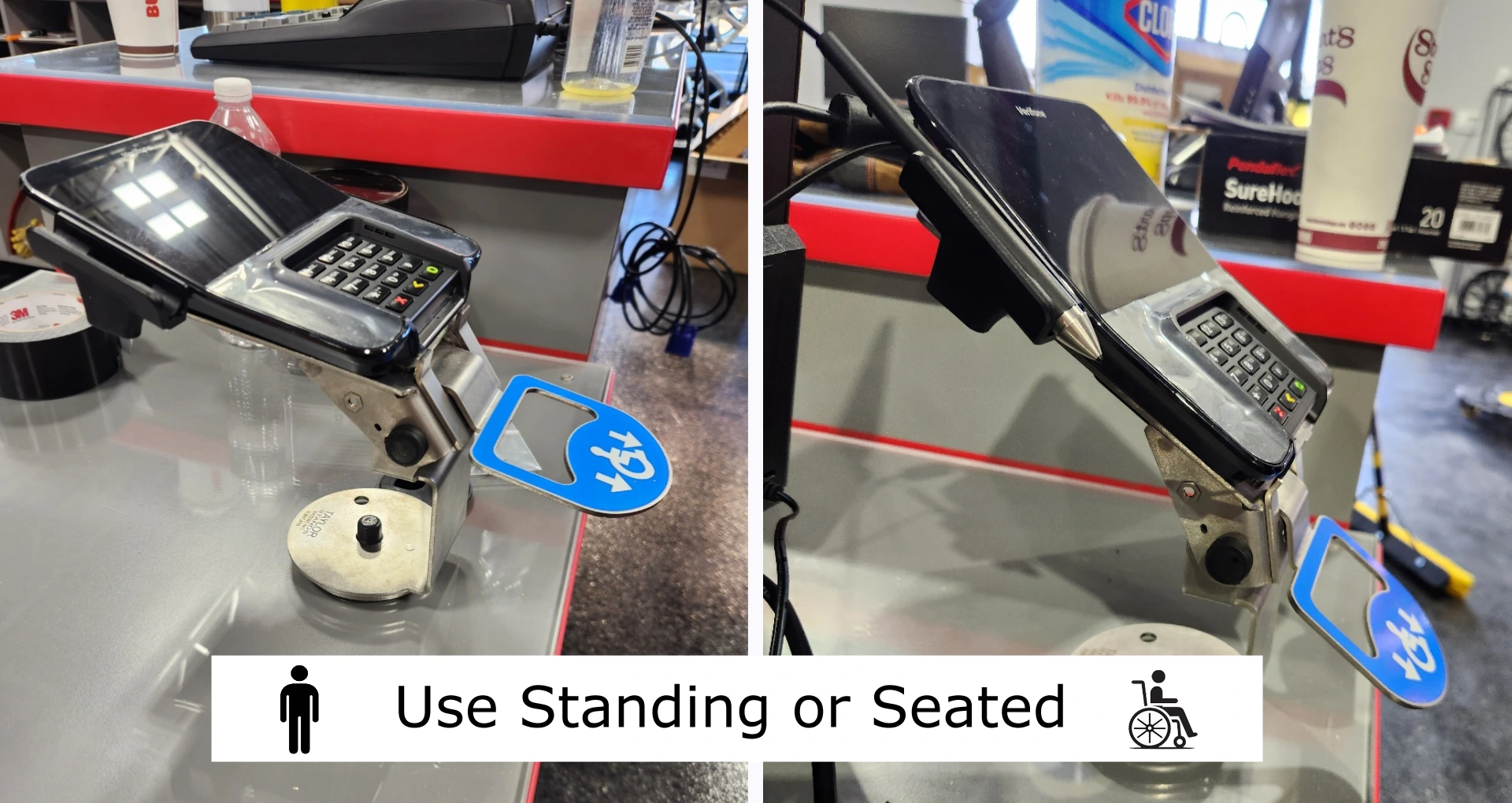
Fresh Install with a Major Tire Store Chain Brand
The above picture shows a new installation for a major tire store chain brand.
They install only Taylor ADA Mounting Stands and our fixed-mount companion, the Sidekick Stand.
Our ADA-compliant stands have been rolled out into every new location — and this has been the standard for four years and counting.
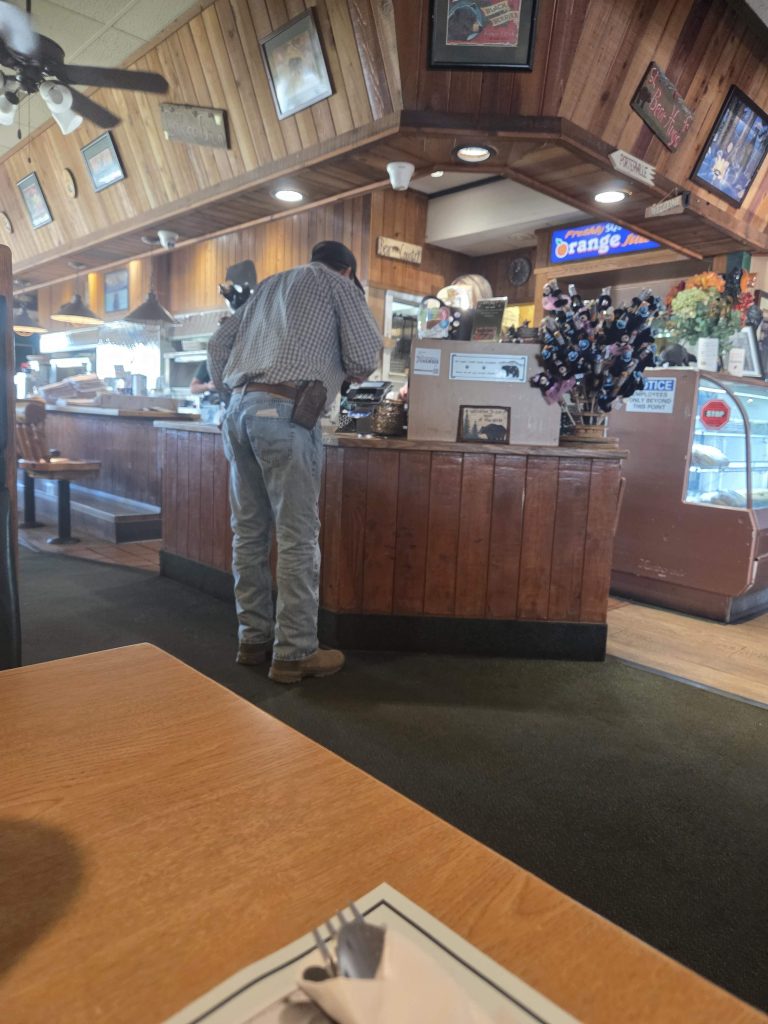
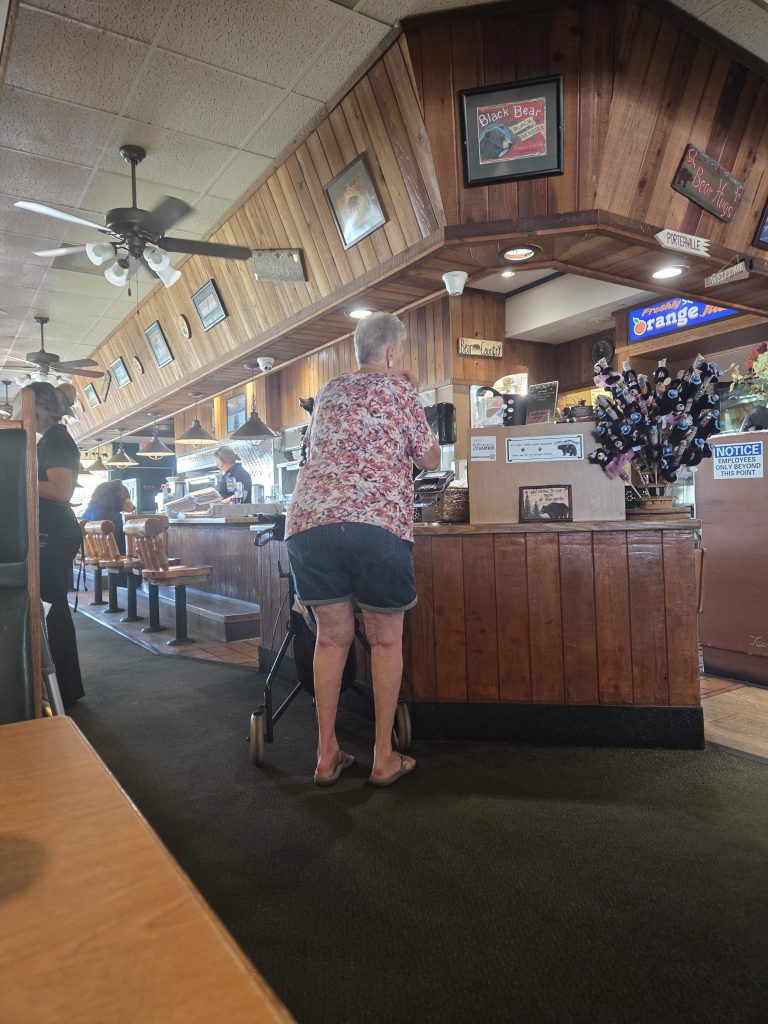
Our ADA Stands are used by all customers and are not limited to only wheelchair users. Keep in mind, people who can walk also have disabilities and also use the Taylor ADA Stand. It is engineered to work for all cardholders. Our mounts are an anti-discrimination mounting. Hard Locked Stands do not have that choice.